Tokenised investments in Malaysia: What would you actually own?
On 6 November 2026, a company announcement distributed by Chainwire said CertiK, V Systems and Malaysian law firm Zaid Ibrahim & Co had signed a memorandum of understanding on institutional tokenisation. The stated aim is to combine blockchain infrastructure, security and legal expertise for financial institutions.
That announcement describes a collaboration. It does not establish that a particular investment is open to Malaysian retail buyers or has received regulatory approval. The useful question for a potential buyer is what the actual product documents promise.
How a tokenised bond or fund differs from Bitcoin
The Securities Commission Malaysia’s FAQ distinguishes tokenised capital market products from digital assets such as digital currencies and tokens. Both may use distributed ledgers, but they are subject to different regulatory frameworks.
A tokenised capital market product digitally represents an existing type of product and its attached rights, provided the underlying characteristics remain intact. Examples include shares, fund units, bonds and sukuk. If the token changes those rights, its legal characterisation can change too.
Bitcoin does not, merely by being held, give its owner a bondholder’s claim on a named issuer or units in an investment fund. For a tokenised bond or fund, those rights depend on the structure and enforceable documents. Similar-looking wallet balances can represent very different obligations.
Five questions to ask before considering a product
The following is an editorial due-diligence checklist, not a claim that the announced collaboration has launched any of these products:
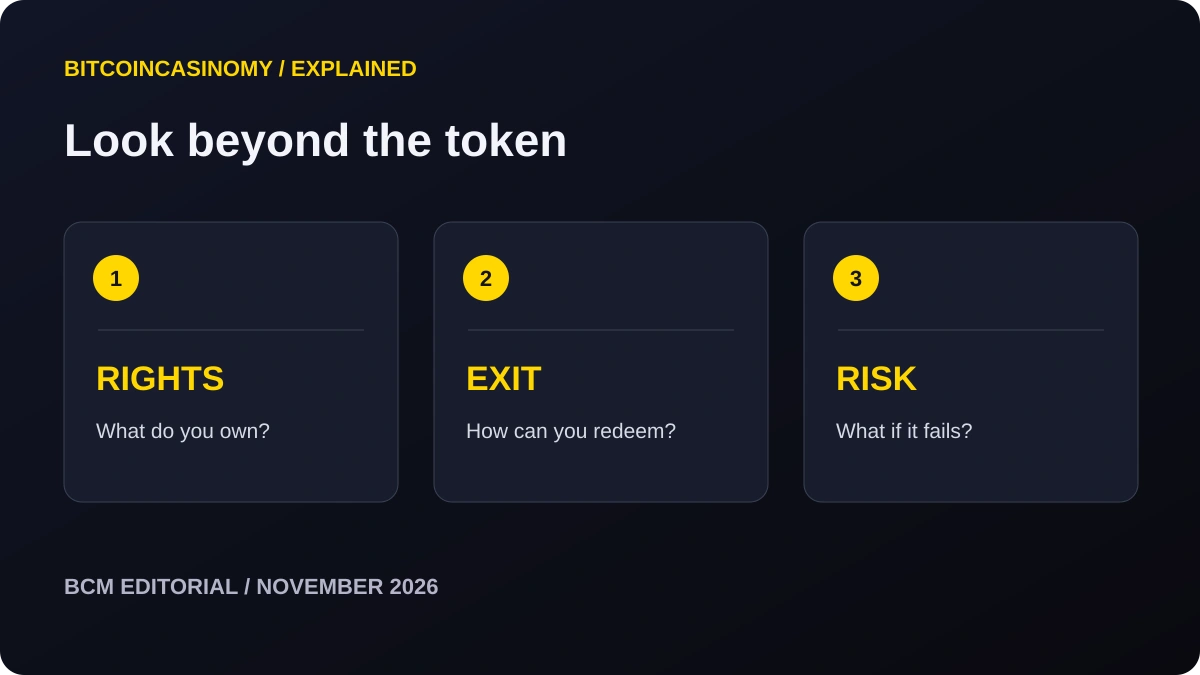
- Who owes the obligation? Identify the legal issuer, not just the platform brand. Ask which document explains the token holder’s claim and which law governs it.
- What does one token represent? Establish whether it represents a direct asset interest, a fund unit, a debt claim or another contractual right. Do not infer ownership of a building, share or reserve asset from a marketing picture.
- How can you exit? Look for eligible holders, minimum redemption amounts, notice periods, dealing windows, fees and payment currency. Ask what happens if redemptions are suspended. A transferable token is not evidence that buyers will always be available.
- Who controls the records and assets? Identify custody arrangements, the authoritative ownership register and the process for correcting errors or replacing access after a lost key. Ask how on-chain and off-chain records are reconciled.
- What happens if something fails? Check the dispute process and the consequences of issuer default, platform closure or a smart-contract incident. Technical recovery and repayment of an investment are different questions.
Request the relevant prospectus, term sheet or offering document. A short social-media post cannot resolve these questions. If the answers are unavailable or inconsistent, pause rather than filling the gaps with assumptions.
Why an audit is only one piece of the picture
A software audit should be read for its scope: which contract version was examined, what findings remained and whether the deployed system matches the reviewed version. It is not a promise about future market value, the issuer’s solvency or the enforceability of a repayment obligation.
The SC identifies legal enforceability, disclosure, technology resilience, lifecycle governance and financial-crime controls as areas intermediaries need to address. Its FAQ says existing requirements for the underlying type of capital market product continue to apply. A blockchain wrapper does not remove those requirements.
Likewise, a reserve figure alone does not explain your priority among creditors or the conditions under which you can redeem. Ask for the documents establishing your own claim, not only a dashboard showing assets elsewhere.
Check the entity and the activity separately
Use the SC Investment Checker to verify whether an individual or entity is authorised for the relevant capital market activity. Match the exact legal identity and use official contact details to investigate discrepancies. A familiar company name in a partnership announcement is not a substitute for checking the seller and product in front of you.
For institutional payment infrastructure rather than investment ownership, our Malaysia and BLOOM explainer covers a separate topic. Neither development establishes approval of casino operators or gambling payments.
Published and sources checked 10 November 2026. The collaboration is described from a company-issued announcement, not an independent product assessment. This article does not recommend an investment, provide legal advice or confirm retail eligibility for any product.