Malaysia joins BLOOM: What could it mean for crypto users?
Bank Negara Malaysia (BNM) joined Singapore’s BLOOM initiative as a policymaker member, alongside the Bank of Thailand, according to the Monetary Authority of Singapore’s 23 October 2026 announcement. BLOOM brings authorities and industry together to work on cross-border digital money, including tokenised deposits and regulated stablecoins.
What BLOOM is working on
Its three priorities are cross-border acceptance and settlement, connections between different digital-money systems, and programmable safeguards such as identity checks and sanctions screening. Maybank is among the participants named in the release. The emphasis is on how institutions and networks work together.
Our reading: the news is relevant to payment infrastructure, but it is not evidence that your current wallet has gained new functions. Product availability needs its own announcement and terms.
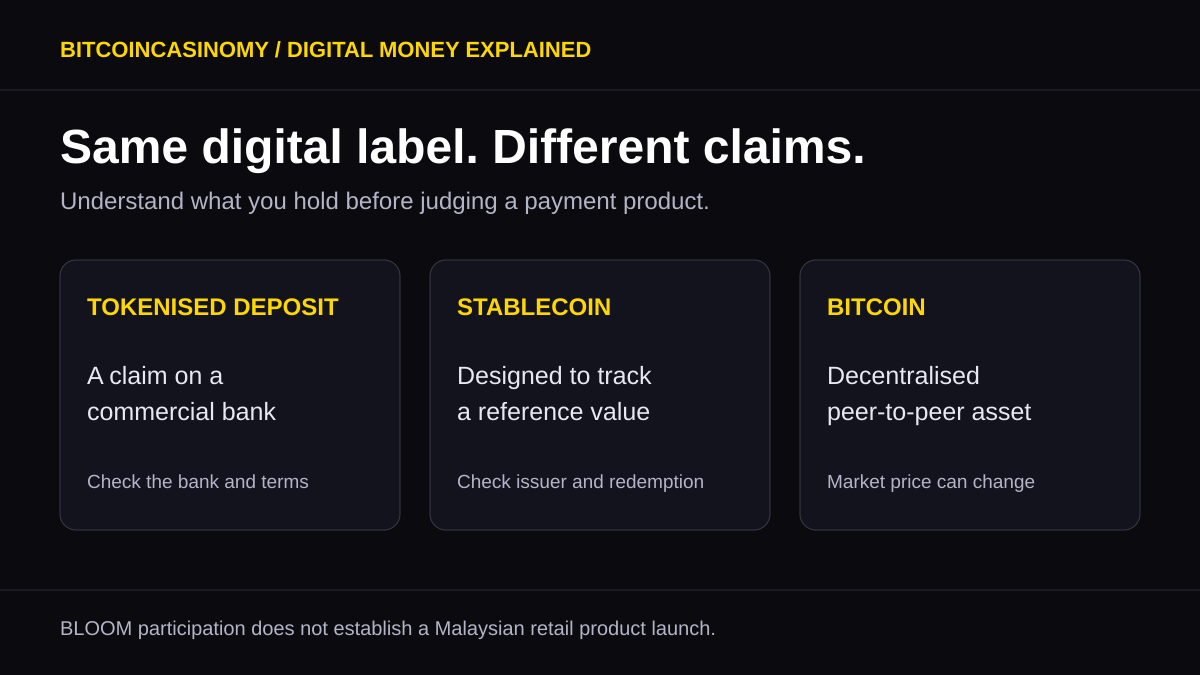
Tokenised deposits, stablecoins and Bitcoin: three different things
Tokenised deposits
A tokenised deposit represents a claim on a commercial bank, recorded in token form. The Reserve Bank of Australia’s explainer describes this as a digital representation of bank deposits. The technology changes how a claim can be recorded and used; the identity of the bank still matters.
Fiat-referenced stablecoins
These are privately issued tokens designed to track a currency through backing assets. A target value is not a guarantee. The BIS comparison of stablecoins and tokenised deposits explains why stablecoins can trade away from their reference value. The issuer, backing and redemption arrangements deserve attention, even when a token is described as regulated.
Bitcoin
Bitcoin operates through a decentralised peer-to-peer network rather than an issuing commercial bank. Its market price moves, and holding BTC does not give you a claim to redeem it from a bank for a fixed currency amount. Bitcoin.org’s FAQ explains the network’s design and price volatility.
These distinctions matter when comparing products. A token label alone does not tell you who owes you money, how you can redeem it, or which risks you face.
What could change for users?
Potential benefits, not promises: Better connections between payment systems could eventually make some international transfers easier to complete. Programmable transactions can execute when specified conditions are met, a capability described in the RBA explainer. Whether that helps an individual customer depends on the service actually offered.
For example, a business paying an overseas supplier would want to know when the supplier receives usable funds, not simply when a token moves. A faster transfer step is useful only if the recipient can access the money on acceptable terms. Foreign-exchange pricing, conversion costs and withdrawal arrangements can still affect the overall experience.
Five questions before relying on a new payment offer
- Who provides it? Match the legal entity in the terms to the company making the announcement. A participant’s familiar brand does not identify every service offered under that brand.
- Who can use it? Check whether access is for banks, businesses or individual customers, and whether Malaysian residents are eligible.
- What do you actually hold? Identify the issuer and whether the balance is a bank deposit, a stablecoin or another asset. Ask what legal claim accompanies it.
- How do you get ordinary money back? Read redemption eligibility, fees, minimums, operating hours and the process if a provider pauses withdrawals.
- What happens if something fails? Look for complaint channels, custody terms, transaction-error procedures and any protection that explicitly covers this particular product. Do not assume protection from a logo or an industry partnership.
This checklist is an editorial framework for evaluating future offers, not a description of a currently available BLOOM retail service. Keep the dated official announcement and product terms so you can compare a promoter’s claim with the actual scope.
What BCM readers should not infer
An infrastructure partnership cannot, by itself, establish approval for an exchange, wallet or gambling operator. If someone uses the BLOOM story to promote a casino or an investment, ask for evidence covering that exact service. This article does not identify a casino payment route or recommend buying a token.
For a related verification checklist, read our guide to checking Malaysia exchange-approval claims. Keep payment technology news separate from claims about a provider’s permissions.
Published 4 November 2026. Sources checked on that date. This is an informational explainer, not investment or legal advice. No accounts, transfers or products were tested for this article.