Is BLOOM safe? Lessons from the Binance and Ledger attacks
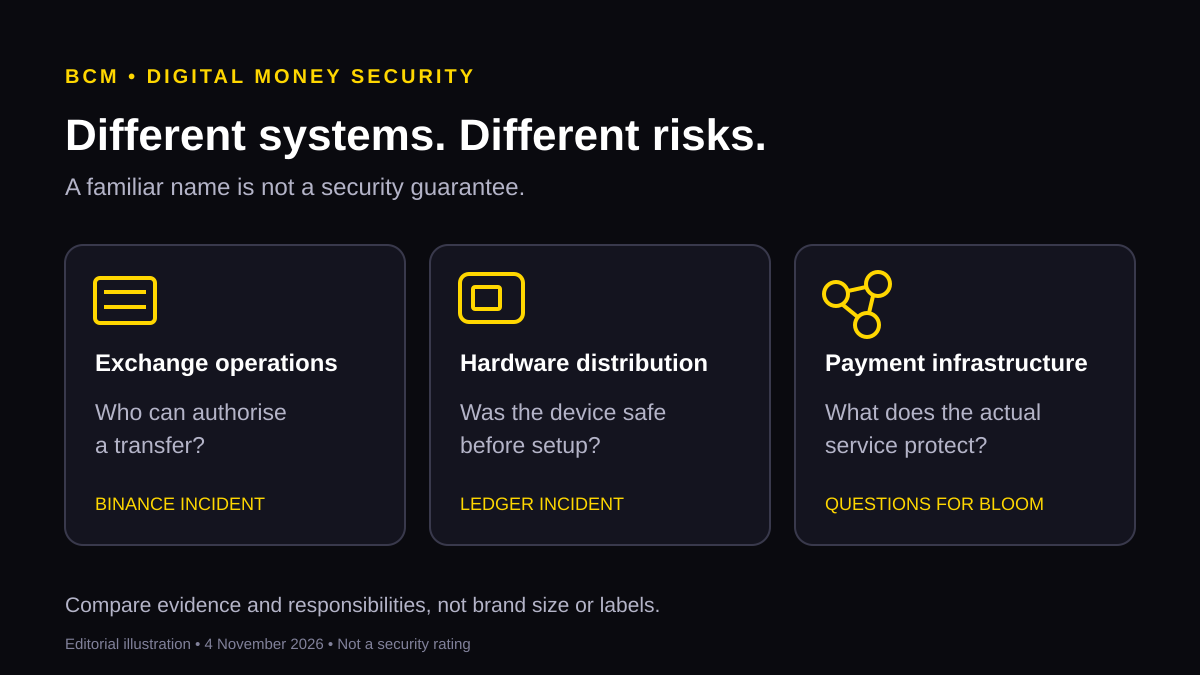
If a major exchange can lose billions and a hardware wallet can arrive with a hidden implant, it is reasonable to ask whether BLOOM deserves our trust. The answer requires separating the systems involved and asking what evidence exists for each one.
13 November update: replenished reserves and withdrawal access are different
In its 13 November 2026 announcement, Binance says it has completed replenishing assets affected by the security incident. It also says withdrawals continue to reopen in phases. The replenishment claim therefore does not establish that every customer can withdraw every asset normally.
Binance dates its latest announced reserve snapshot to 12 November 2026 at 00:00 UTC, covering 198 tokens. At announcement, it said the full zero-knowledge verification proof would take approximately 40–50 hours to generate. We have not independently verified completion of that proof or the backing of individual balances.
These are company statements, not an independent financial or security audit. The notice gives no universal withdrawal date for Malaysian users, whether their balance is small or large. A snapshot concerns a particular point in time; it does not promise future solvency or uninterrupted access.
Three checks that answer different questions
- Reserve evidence: use the dated report and account-verification information on Binance’s official Proof of Reserves page. Check which assets and reporting period the evidence covers. We have not verified any reader’s account.
- Withdrawal availability: check the current status for the exact asset and network inside the official account, plus any account-specific restrictions. A supported token on one network does not establish availability on another. Keep records if a request remains pending.
- Malaysian registration: the Securities Commission’s exchange-operator list, checked on 13 November, does not list Binance. Replenishing reserves does not change regulatory registration.
Do not send an extra payment to an unsolicited contact claiming it will unlock a withdrawal. Open the official service yourself and use its support channel to query a restriction. This update is not an instruction to transfer funds, a guarantee of recovery or a recommendation to use Binance.
First, which BLOOM are we talking about?
This article concerns the Monetary Authority of Singapore’s Borderless, Liquid, Open, Online, Multi-currency initiative. It is a public-private effort to develop settlement infrastructure, including tokenised bank money and stablecoins meeting regulatory expectations. It is not a consumer hardware wallet or the similarly named Bloom Trading bot.
The 23 October 2026 MAS announcement says Bank Negara Malaysia and Bank of Thailand joined as policymaker members. Its priorities include cross-border settlement, interoperability and programmable controls such as identity verification, sanctions screening and transaction controls. The announcement does not give Malaysian consumers a retail sign-up process.
Binance: what the recent hack actually shows
Binance’s 3 November 2026 initial incident report describes its 29 October attack and estimates approximately US$6.34 billion in affected assets. According to Binance, a campaign involving malicious downloads, fake recruitment interviews and compromised internal tooling reached its wallet-signing service. Attackers then initiated transactions outside the normal withdrawal process.
On Ethereum, Binance says the attacker used EIP-7702 delegation to give a malicious smart contract execution rights over a hot wallet. Suspending ordinary withdrawals did not automatically cancel those on-chain permissions. The company says it rebuilt affected systems and is arranging independent review; its investigation remains ongoing.
The initial report also said Binance would absorb the financial loss. A later replenishment and withdrawal update is summarised above. These remain company statements, not our independent confirmation of repayment or a guarantee against another incident. This is the October 2026 event, not Binance’s separate 2019 breach.
The lesson for evaluating BLOOM-related services: protecting keys is only one part of security. Who can instruct a signing service, change transaction rules or exercise delegated permissions also matters. A recognised institution still needs controls that work when staff devices or operational systems are compromised.
Ledger: physical tampering is a real risk
The recent Ledger case also deserves a precise description. In its response updated 15 October 2026, Ledger says criminals opened genuine devices, added hidden components to capture recovery phrases during setup, and returned the devices to distribution through resellers in Southeast Asia.
Ledger says its chip, operating system and servers were not compromised, describing the incident as a localised distribution-channel attack after devices left its control. It says it suspended authorised sales in Southeast Asia and Hong Kong and tightened reseller handling rules. These are the manufacturer’s findings and response, rather than an independent certification of every device.
A stolen recovery phrase can give an attacker control of a wallet without needing the owner’s device later. Calling a wallet “cold” does not protect a phrase that was already exposed during setup. Hardware provenance and the recovery process therefore belong in the security assessment.
Do not mix up three different Ledger incidents
- October 2026: the hardware-implant and distribution case described above.
- December 2023: Ledger’s Connect Kit incident report describes malicious software distributed through a JavaScript package used by decentralised applications, leading users to sign draining transactions. This was a software supply-chain incident.
- 2020: the customer-database breach exposed contact information. That privacy breach was different from extracting keys from a hardware wallet.
What BLOOM’s safeguards can and cannot tell us
Identity checks and sanctions screening can help a payment system enforce rules. They do not, by themselves, demonstrate resistance to malware, stolen administrative access, malicious transaction approvals or tampered equipment. This is our analysis of the difference between compliance functions and cybersecurity, not a finding that BLOOM lacks security work.
Likewise, an initiative involving central banks is not automatically a guarantee of repayment for every token, wallet or provider associated with it. The relevant question is which institution owes the customer money and what the specific product terms and applicable protections say.
The documents reviewed establish BLOOM’s objectives and participants. They do not establish a single consumer custody model, a universal loss-compensation promise or an independently tested security rating covering all future implementations. It would be premature to rank the whole initiative above Binance or Ledger on that evidence.
Six checks before trusting a BLOOM-linked offer
The following is an editorial due-diligence checklist, not a claim about features already deployed:
- Identify the actual service. Find its legal provider and official product documentation. A reference to BLOOM or BNM is not enough.
- Map control of the money. Ask who holds keys, who can approve transfers, and who can change those permissions.
- Check the security evidence. Look for the date, scope and findings of independent assessments. A narrow smart-contract audit does not certify staff laptops, support procedures or hardware distribution.
- Understand emergency controls. Ask what can be paused, revoked or recovered after a compromise and who is responsible for acting.
- Read the loss and redemption terms. Establish what happens after theft, a provider failure or an unavailable withdrawal. Do not assume deposit protection applies to an unspecified token.
- Protect the setup and recovery process. Verify software and hardware sources, and never provide recovery phrases to unsolicited support contacts.
MAS’s BLOOM page specifically warns that MAS and companies participating in its initiatives will not ask for personal banking information, security login credentials or wallet private keys. Treat unsolicited requests to transfer money for a supposed BLOOM opportunity as a reason to stop and verify.
So, is BLOOM safe?
There is no responsible yes-or-no verdict for an entire infrastructure initiative based on its announcement. The useful conclusion is narrower: BLOOM has stated policy and operational aims, while the security of any real service must be assessed at the provider, software, custody and user-access levels.
The Binance and Ledger cases show why familiar names and a strong design concept are not sufficient evidence. They do not establish that all digital-money systems are equally unsafe, or that BLOOM is automatically safer. Demand the details of the service you would actually use.
For background, read our explainer on Malaysia joining BLOOM. Neither article recommends a token, exchange or casino payment route.
Published 4 November 2026. Binance reserve and withdrawal section updated with sources checked 13 November 2026; other incident and BLOOM background was checked on 4 November. Incident descriptions are attributed to the organisations’ published reports and may develop. This is an informational risk explainer, not investment or legal advice, a security audit, or a live service-status report. We did not test BLOOM implementations, Binance systems or Ledger devices.